
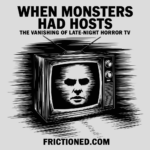

When Horror Had a Human Face
There was a time when horror didn’t just start playing.
It arrived.
Usually after midnight.
Usually unannounced.
Usually hosted by someone who looked like they lived in the TV.
Before streaming queues and autoplay, horror came with a face, a voice, and a sense of occasion. You didn’t just stumble into a movie—you were welcomed into it. The host cracked a bad joke. Warned you about the budget. Teased the monster. Let the fog machine hiss. Then they sent you into the darkness like a guide who’d already been there and survived.
Late-night horror hosts were part ringmaster, part camp counselor, part fellow insomniac. They weren’t polished. They weren’t efficient. They didn’t pretend the movie was good. They made it fun. And more importantly, they made it shared.
You weren’t alone on the couch.
Someone else was awake with you.
That’s the part people forget. Horror hosts weren’t just about horror. They were about company. About having a human buffer between you and whatever low-budget creature crawled out of the screen. They created a ritual—commercial breaks, asides, sarcasm, local in-jokes—that turned disposable movies into memories.
Then they vanished.
Not with a final episode. Not with a farewell monologue. Just… gone. Replaced by silent menus, thumbnails, and algorithms that never talk back. Horror is everywhere now. Infinite. On demand. Yet somehow lonelier than ever.
This isn’t a nostalgia piece about rubber monsters and bad makeup.
It’s about what disappeared when we removed the human from the horror.
Because when horror lost its hosts, it didn’t just lose a format.
It lost its face.
What Late-Night Horror Hosts Actually Were
Late-night horror hosts weren’t presenters in the modern sense. They didn’t read a teleprompter. They didn’t optimize engagement. They didn’t pretend to be neutral.
They were curators.
Their job wasn’t to sell you a movie. It was to sit next to it. To frame it. To make sense of why this particular cheap, dusty reel was worth your insomnia tonight. Sometimes that meant hyping it up. More often, it meant gently warning you what you were in for.
They acknowledged the seams.
A host might tell you the monster barely appears. Or that the effects fall apart in the third act. Or that the plot makes no sense if you think about it too hard—so don’t. That honesty created trust. You weren’t being sold to. You were being let in.
They were also comedians, but not stand-ups. Their humor came from context. From shared absurdity. From reacting to the same nonsense you were about to watch. The joke wasn’t just the punchline—it was the movie itself, and the host was laughing with you, not over you.
Most importantly, they were local.
Many horror hosts existed only in certain cities, on certain stations, at certain hours. They referenced local weather. Local ads. Local rumors. You could grow up believing your horror host belonged to your town, like a crypt keeper who rented a studio downtown and only came out after midnight.
That intimacy mattered.
Shows like Elvira, Svengoolie, and Joe Bob Briggs weren’t just branding exercises. They were personalities built through repetition, limitation, and presence. You didn’t binge them. You met them once a week. Or once a night. Or whenever the station felt like airing them.
Even generic formats like Creature Features worked because the host acted as a human buffer between you and the screen. Someone to reset your nerves after a commercial break. Someone to reframe a scene you just watched. Someone to keep the experience grounded.
Late-night horror hosts were slow by design. Inefficient on purpose. They interrupted the movie. They broke the spell. And paradoxically, that made the horror hit harder—because it came in waves, not a constant stream.
They weren’t content.
They were company.
The Golden Age: Why They Thrived
Late-night horror hosts didn’t rise because television believed in them.
They thrived because television didn’t know what to do with late night.
After the evening news signed off and the affiliates stopped caring, the hours after midnight became a wasteland. Cheap airtime. Low expectations. Little oversight. Stations needed something—anything—to fill the void. Horror movies were inexpensive, plentiful, and already half-forgotten. Add a host, a fog machine, and a sense of humor, and suddenly dead time turned into destination viewing.
This was the perfect ecosystem for weirdness.
There were no analytics dashboards. No engagement graphs. No brand safety meetings. The audience was assumed to be small and strange, which meant nobody tried to sand it down. Horror hosts flourished precisely because they existed where no one important was watching.
Late night also belonged to outsiders.
Kids who stayed up too late. Teenagers sneaking TV after their parents went to bed. Shift workers. Insomniacs. People who didn’t quite fit the daytime schedule. Horror hosts spoke directly to that audience without pretending otherwise. They didn’t chase mass appeal. They acknowledged who was awake—and why.
The timing mattered.
After midnight, television became a liminal space. The rules loosened. Commercials felt surreal. The signal got fuzzy. Jokes landed differently. A rubber monster felt scarier at 1:17 a.m. than it ever would at 4:00 in the afternoon. Horror hosts understood that mood intuitively. They leaned into it instead of trying to clean it up.
And crucially, horror was still considered disposable.
These movies weren’t prestige. They weren’t protected. They were chopped up for time, interrupted by ads, and aired in whatever order the station felt like. That lack of reverence freed the hosts. They could mock the film, celebrate it, or do both at once. There was no sacred canon to defend.
The result was a strange alchemy.
Cheap movies + low stakes + human presence = culture.
The Golden Age of horror hosts wasn’t about quality control or artistic preservation. It was about permission. Permission to be strange. Permission to be amateur. Permission to talk directly to the audience like co-conspirators instead of consumers.
It worked because nobody tried to optimize it.
And the moment television started paying attention, the magic began to fade.
Cable, Corporatization, and the First Cracks
The first cracks didn’t come from streaming.
They came from success.
As cable expanded in the 1980s and 1990s, television stopped being local and started becoming national. What had once been dozens of weird little stations turned into branded pipelines. Consistency replaced personality. Predictability replaced permission.
Late-night was no longer a dumping ground.
It was inventory.
Cable networks needed shows that could air everywhere, the same way, every time. That was the opposite of what horror hosts were built for. Their charm came from looseness—inside jokes, regional references, improvisation, and the occasional on-air mistake. All of that looked like liability once television started thinking in terms of scale.
Personality became “risk.”
A host who mocked the movie too hard might offend a distributor. A joke might upset an advertiser. A costume might trigger a standards review. Suddenly, every aside needed approval. Every interruption needed a reason. Horror hosts had thrived on being slightly out of control, and control was now the priority.
National cable also flattened tone.
A host who felt perfect at 1:30 a.m. on a local UHF station felt weird at 9:00 p.m. on a national network. The late-night spell broke when executives tried to make it respectable. The fog machine looked cheap under brighter lights. The pauses felt awkward when trimmed for pacing. The magic didn’t scale—and instead of accepting that, networks tried to sand it down.
At the same time, horror itself was being rebranded.
The genre started chasing legitimacy. Prestige directors. Serious criticism. Film festival credibility. Horror was no longer supposed to be silly or disposable. Hosts who laughed at rubber monsters didn’t fit the new narrative. Irony was out. Earnestness was in.
What survived were compromises.
Hosts became more scripted. Segments got shorter. Interstitials were minimized. The movie became the product again, not the experience around it. The host stopped being a guide and became a garnish.
This wasn’t the end yet—but it was the beginning of the end.
Once horror hosting had to justify itself to advertisers, lawyers, and brand managers, it stopped being a late-night secret. And once television decided it needed to understand the format, it quietly lost interest in letting it live.
The Streaming Era: Content Without Hosts
Streaming didn’t kill horror.
It dissolved the container that horror lived in.
When platforms replaced channels, the idea of a “late-night slot” vanished. Time stopped mattering. Midnight became just another timestamp. Horror moved from an event you waited for into a category you scrolled past.
And the host became unnecessary.
Streaming platforms don’t want guides. They want throughput. The goal isn’t to ease you into a movie or frame the experience—it’s to keep you watching. Anything that slows that down is friction. Intermissions, commentary, personality, pauses? All liabilities.
So they were removed.
What replaced them was the algorithm: silent, invisible, and relentlessly efficient. Instead of a human saying, “Stick with this one—it gets weird in the third act,” you get a row of thumbnails calculated from viewing history you barely remember creating.
There’s more horror now than ever.
And less context than ever.
Without hosts, movies arrive naked. No warnings. No tone-setting. No shared joke to soften a bad effect or elevate a dumb premise. You’re expected to decide, instantly, whether something deserves your attention—based on a still frame and a tagline written by someone optimizing clicks.
Watching also became solitary.
Late-night horror used to feel communal, even if you were physically alone. You knew other people were awake, watching the same thing, at the same time. Streaming severed that synchronicity. Everyone is watching everything at different moments, in different orders, with no shared rhythm.
The movie starts immediately.
And ends immediately.
Then another begins.
No breathing room. No decompression. No voice to reset your nerves or laugh off what you just saw. Horror becomes a continuous feed instead of a punctuated experience. The fear doesn’t linger—it scrolls.
Even when platforms try to recreate hosting, it’s usually cosmetic.
A brief intro. A title card. A “curated collection” label slapped on a grid. But curation without presence isn’t hosting. It’s categorization. It tells you what something is, not why you should care.
Streaming didn’t just remove the horror host.
It removed the idea that horror needed mediation at all.
And in doing so, it turned a genre built on atmosphere, anticipation, and shared unease into just another content vertical—endless, efficient, and strangely quiet.
What We Lost (That People Don’t Talk About)
When late-night horror hosts disappeared, we didn’t just lose a format.
We lost a set of quiet skills that nobody realized were being taught.
Horror hosts taught how to watch.
They showed you how to enjoy something that wasn’t objectively “good.” How to laugh at bad effects without dismissing the movie entirely. How to appreciate mood, timing, and atmosphere over polish. They trained a kind of media literacy that didn’t rely on ratings or reviews—just attention and attitude.
They also normalized taste without shame.
A host could love a ridiculous monster movie and admit it was terrible in the same breath. That permission mattered. It said you didn’t need irony armor or critical credentials to enjoy something strange. You didn’t have to defend your interest. You just had to stay up late enough to feel it.
We also lost shared pacing.
Horror hosts interrupted the movie on purpose. They broke tension, then rebuilt it. They gave your nervous system a moment to breathe. Commercial breaks weren’t just ads—they were pauses. Time to process what you’d seen. Time to laugh it off before diving back in.
Streaming removed those breaks.
Now horror plays straight through, optimized for momentum instead of memory. Scenes blur together. Endings feel disposable. The movie stops, and another begins before anything has time to settle.
We lost companionship.
Not social interaction. Something subtler.
The feeling that someone else was awake with you. Someone strange, unslept, and a little off-kilter. Horror hosts acknowledged the loneliness of late night without trying to fix it. They didn’t ask questions. They didn’t demand engagement. They just showed up and stayed.
That kind of presence doesn’t translate to comment sections or reaction videos. It wasn’t participatory—it was parallel. You watched together without needing to speak.
And finally, we lost friction.
Hosts slowed things down. They made you wait. They made you sit through nonsense. They made the experience imperfect. In a media environment obsessed with efficiency, that friction looked like a flaw.
It wasn’t.
It was the point.
Late-night horror used to be a space where nothing was urgent, nothing was optimized, and nothing needed to justify its existence beyond the fact that you were still awake. When the hosts vanished, that space collapsed.
We didn’t just lose guides.
We lost the pauses that made the fear—and the fun—stick.
The Survivors and Holdouts
The disappearance of horror hosts wasn’t total.
A few survived—not by adapting to the system, but by refusing to fully enter it.
The clearest example is Svengoolie. Still broadcasting on MeTV, still leaning into corny jokes, rubber chickens, and deliberate awkwardness, Svengoolie works because he exists slightly outside modern television logic. The show isn’t trying to go viral. It isn’t chasing relevance. It’s ritual. Same time. Same tone. Same refusal to hurry.
That consistency is the point.
Svengoolie survives because the audience knows exactly what they’re getting—and wants it that way. The show feels less like content and more like a standing appointment. Miss it, and you miss it. That alone is a quiet rebellion in an on-demand world.
Then there’s Joe Bob Briggs, whose return with The Last Drive-In with Joe Bob Briggs proved something important: the format didn’t fail. It was abandoned.
Joe Bob didn’t streamline. He doubled down. Longer runtimes. Longer interruptions. Tangents. Trivia. Rants. Moments of silence. He treated hosting not as a novelty but as the main event. The movie was almost secondary.
And it worked—because it asked something of the audience.
You had to show up live. You had to commit. You had to sit with it. Shudder didn’t succeed by modernizing horror hosting; it succeeded by letting it remain stubbornly inefficient.
That’s the common thread among the holdouts.
They survive in bounded spaces. Niche platforms. Older networks. Subscription models where the audience opts in deliberately. Places where viewers are allowed to be patient and weird again.
What you don’t see are horror hosts thriving on mainstream streaming homepages.
Because the format only works when it’s allowed to be slow, opinionated, and human. It needs room to ramble. To interrupt. To be slightly irritating. Algorithms hate that.
The survivors prove the demand never vanished.
Only the tolerance did.
Horror hosts didn’t disappear because people stopped wanting them.
They disappeared because most platforms no longer allow anyone to stand between the viewer and the feed.
Could Horror Hosts Come Back?
Technically?
Absolutely.
Culturally?
That’s the problem.
There has never been a cheaper or easier time to create a horror host show. Cameras are inexpensive. Distribution is instant. Audiences are global. Anyone with a basement, a costume, and a personality could build what once required a television station and a UHF signal.
And yet, almost no one does.
The obstacle isn’t production. It’s permission.
Modern platforms are built around removal. Remove friction. Remove pauses. Remove intermediaries. Horror hosts, by definition, are intermediaries. They slow the experience. They insert opinion. They interrupt the feed and ask the viewer to stay anyway.
That runs against everything the system rewards.
Platforms don’t want gatekeepers between the viewer and the content. They want direct consumption, immediate reaction, and measurable engagement. A horror host asking you to sit through a five-minute monologue before the movie starts looks like a defect, not a feature.
Trust is another missing ingredient.
Late-night horror hosts worked because viewers trusted them to waste their time well. They didn’t promise optimization. They promised companionship and taste. Modern media has trained audiences to be suspicious of anything that doesn’t get to the point immediately. Attention has become defensive.
There’s also the problem of scale.
Horror hosts don’t scale cleanly. They don’t work for everyone. They never did. The format thrives on specificity—one voice, one tone, one sensibility. That makes it powerful, but it also makes it incompatible with mass platforms that need to offend no one and please everyone just enough.
When revivals do happen, they often misunderstand the assignment.
They focus on aesthetics instead of presence. A retro set. A wink to the past. A short intro before the movie auto-plays. That’s not hosting. That’s decoration. The magic wasn’t the outfit—it was the relationship built over time.
So could horror hosts come back?
Yes—but not everywhere.
They’ll live where audiences choose experience over convenience. Where time is part of the contract. Where someone is allowed to say, “Stick around. This matters. Trust me.”
The format doesn’t need a resurrection.
It needs a habitat.
Until platforms are willing to value slowness, opinion, and human interruption again, horror hosts will remain what they’ve become now: rare, beloved holdouts—flickering on the edges, waiting for someone to turn the lights down and stop scrolling.
Horror Hosts as a Symbol of a Bigger Loss
The disappearance of horror hosts wasn’t an isolated change in television.
It was a symptom.
What vanished with them was an entire layer of culture that existed between the audience and the machine. Horror hosts were never just about movies—they were part of a broader ecosystem of local media, late-night weirdness, and human mediation that no longer fits inside optimized systems.
They belonged to a world where media wasn’t perfectly efficient.
Local stations had dead air to fill. DJs talked too long. Hosts went off-script. Shows existed because someone wanted them to, not because they tested well. Horror hosts lived in those gaps—the spaces modern media has spent decades trying to eliminate.
When local television collapsed, something else collapsed with it: context.
Horror hosts contextualized what you were watching and why. They created a frame around the content that made it feel intentional instead of random. Streaming replaced that with abundance. Infinite choice without guidance. Access without atmosphere.
Late night itself disappeared.
Once, after midnight felt like crossing a border. The rules changed. The audience thinned. The tone softened or sharpened depending on who was awake. Now every hour looks the same. Every screen feels identical. The day never really ends—it just refreshes.
Horror hosts thrived in liminal time.
So did call-in radio. So did public-access TV. So did weird local commercials and accidental community rituals. All of it depended on friction, delay, and a shared schedule. When everything became on-demand, those rituals lost their anchor.
The loss goes deeper than nostalgia.
It’s the loss of being addressed instead of targeted. Horror hosts spoke to viewers, not at demographics. They weren’t optimized for segments—they were people talking to other people who happened to be awake at the same hour.
That kind of address doesn’t scale.
And that’s exactly why it mattered.
Horror hosts didn’t fail because audiences outgrew them. They failed because the systems that supported them were dismantled in favor of smoother, quieter, more efficient consumption.
What replaced them works.
But it doesn’t linger.
The disappearance of horror hosts marks the moment when media stopped leaving room for strangers to sit with us in the dark—just long enough to make the fear feel shared, and therefore survivable.
The Monsters Are Still Here—The Hosts Are Gone
The monsters never left.
They multiplied.
There are more horror movies now than ever before. More subgenres. More budgets. More access. You can summon terror in seconds, on any screen, at any hour. Horror didn’t disappear—it was perfected, categorized, and made endlessly available.
What vanished was the invitation.
Horror hosts didn’t protect us from the monsters. They prepared us for them. They set the mood. They broke the tension. They reminded us that fear could be playful, communal, and survivable. Without them, horror became something you consume alone, quickly, and forget just as fast.
The hosts weren’t gatekeepers.
They were guides.
Their disappearance wasn’t the result of changing tastes. It was the result of changing systems—systems that don’t tolerate interruption, personality, or time spent not moving forward. A human standing between you and the feed became unacceptable.
So the feed won.
And in winning, it flattened the experience.
Today, horror arrives instantly and leaves no residue. There’s no pause to laugh, no moment to recover, no voice to say, “Yeah, that was ridiculous—but kind of great, right?” The screen goes dark, the next suggestion loads, and the night keeps going without you.
The monsters are still here.
They’re louder. Sharper. Better produced.
But they arrive without ceremony.
Without context.
Without company.
Late-night horror hosts didn’t die out because they were outdated. They disappeared because they belonged to a slower, stranger, more human media ecosystem—one that valued shared experience over seamless delivery.
Maybe they don’t need to come back everywhere.
But their absence tells us something important about what we’ve lost: not fear, not imagination, not even community—but the quiet comfort of knowing that somewhere, just off-screen, someone else was awake with us, laughing at the darkness and waiting for the next commercial break.