For a generation of suburban teenagers, a cluster of fast-food counters became a gathering place. The freedom was real enough to matter—and conditional enough to disappear.
The Glow You Didn’t Question
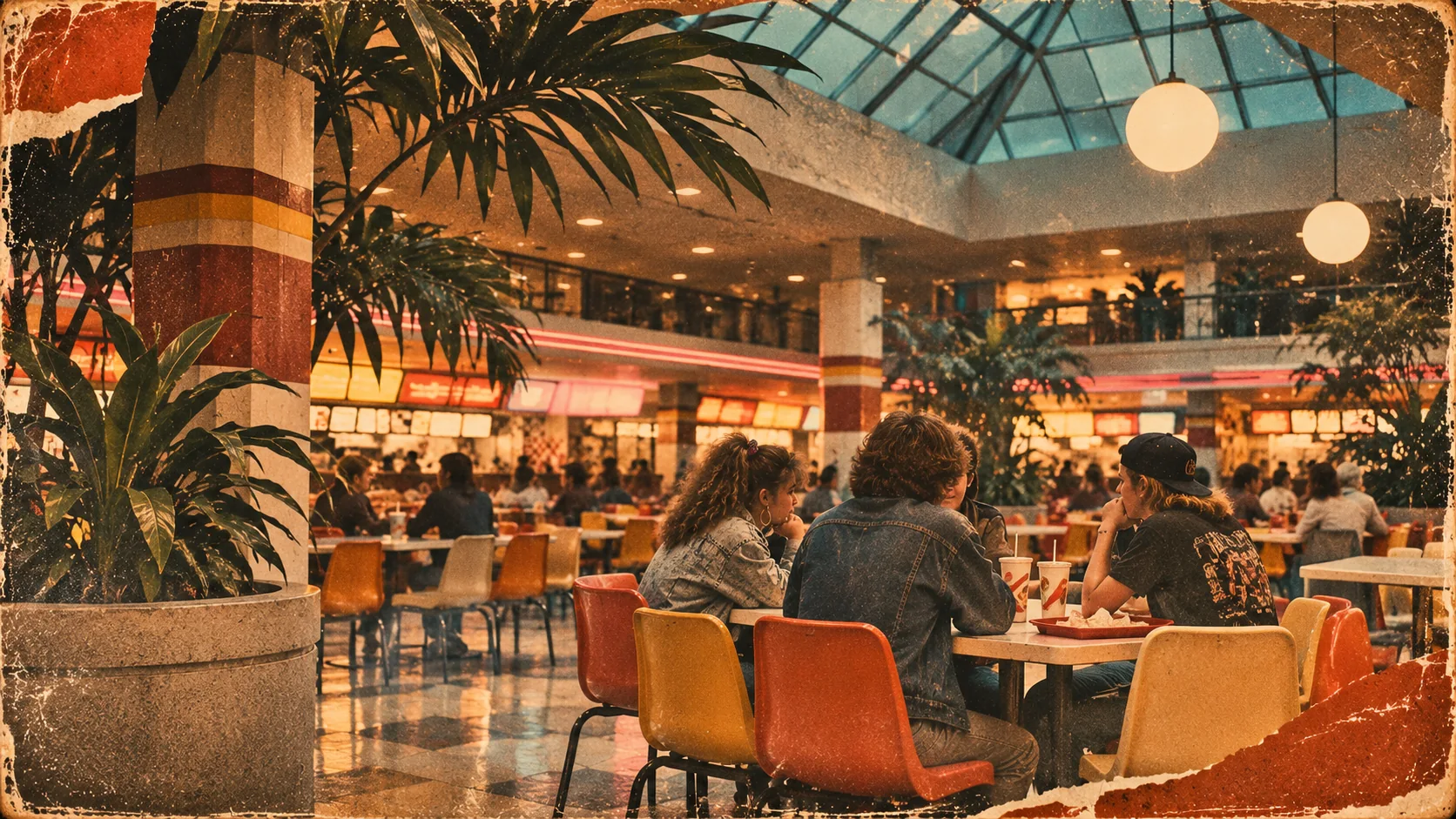
The food court smelled like everything at once. Fry oil. Sugar. Hot plastic. A cleaning solution strong enough to erase the evidence of lunch. Trays scraped across laminate tables. Shoes squeaked against tile. Somewhere, a soda machine hissed like it was impatient.
Under the skylights and fluorescent panels, afternoon seemed to last forever. Groups formed, dissolved, and formed again. Somebody guarded a table while everyone else went looking for food. Somebody waited for a ride. Somebody had come only to find out who else was there.
It looked like a place to eat. For a generation of suburban kids, it was also somewhere to be.
The mall food court was never a true town square. That is precisely why its brief career as one is so interesting.
A Town Square with a Closing Time
Traditional public spaces are messy by design: people pass through for reasons that do not have to satisfy a landlord. A shopping mall offered a different arrangement. It provided indoor streets, benches, bathrooms, air conditioning, and a reasonably predictable place to meet. All of it belonged to somebody.
As suburban development spread destinations farther apart, the enclosed mall became an especially convenient gathering place in many communities. Not the only gathering place, and not a replacement for every downtown. But for families with cars and teenagers without them, it could feel like the center of the map.
The food court concentrated that social life. You did not need to enter a store or pretend to be searching for a sweater. For the price of fries—or sometimes nothing at all—you could join the room.
The important distinction was almost invisible when the room was full: you could be welcomed as a visitor without possessing any right to remain.
A Practice Run at Being a Person
Remember the peculiar politics of a food-court table. Who saved the seats. Who sat next to whom. Who walked by three times without saying hello. Who had a job at the counter and therefore knew everyone’s order—and everyone’s business.
For teenagers, the mall offered a manageable version of independence. A parent could drop you off; a security guard might be nearby; your friends could disappear around a corner without disappearing into the city. It was supervised freedom, but the freedom still mattered.
You practiced the small, awkward negotiations of public life: joining a group, leaving one, introducing yourself, being rejected, doing nothing without an adult assigning the activity a purpose. You learned the difference between being alone and being on display.
No one needed to call it civic education. It happened between paper cups and cold French fries.
The Menu Wasn’t the Main Event
The signs advertised pizza, burgers, chicken, tacos, noodles, pretzels, and ice cream. The variety differed by mall, era, and region, but the structure felt familiar: several counters surrounding a shared seating area.
The food mattered, naturally. It also supplied a socially acceptable excuse to stay. A tray made you a customer. A customer could occupy a chair. And once you had the chair, the actual business could begin: watching, talking, arguing, flirting, waiting.
The food court mixed groups that might otherwise have passed each other without stopping. Office workers on lunch, grandparents with shopping bags, young families, tired employees on break, and teenagers stretching a single drink into an afternoon all shared the same background noise.
It did not erase differences in money or status. A kid counting change and a kid with unlimited spending money were not having the same afternoon. But for a few minutes they might be sitting at neighboring tables, hearing the same terrible overhead music.
Whose Table Was It Anyway?
The arrangement contained a contradiction from the beginning. The mall benefited from crowds; the crowd was part of the atmosphere that made the place feel alive. But a crowd that lingered too long, spent too little, or frightened other customers could also look like a problem to management.
By the 1990s, that tension was becoming explicit. In October 1996, the Mall of America began requiring visitors younger than sixteen to have an adult escort on Friday and Saturday evenings after 6 p.m. Other malls adopted variations of parental-escort rules in subsequent years. These policies were neither universal nor proof that malls had suddenly stopped welcoming young people; they reflected ongoing conflicts about safety, commerce, and who belonged in a privately owned gathering place.
The 1996 policy provoked opposition as well as support. That is the point worth remembering. What one group considered a reasonable safety measure, another could experience as the loss of a rare place to go.
A real town square can have rules, too. The difference is that its purpose is not ultimately measured in sales per square foot. A mall food court could feel communal and still be governed by retail priorities.
The Part Nostalgia Leaves Out
It is easy to remember only the bright signs and the improbable freedom of wasting three hours with friends. The memory is attractive because it contains real pleasures. It also edits out a few things.
The food court could be noisy, expensive, exclusionary, and uncomfortable. Not every town had a mall. Not every kid had a ride, or enough money to blend in, or a group waiting at a table. Some people felt watched more closely than others. And the employees who kept the whole place working were not there to kill time.
None of that cancels what the space offered. It makes the story more honest. The mall was not a lost utopia. It was a commercial environment that accidentally accommodated a recognizable form of public life.
Its limitations were built into the same walls that made it convenient.
The Empty Table
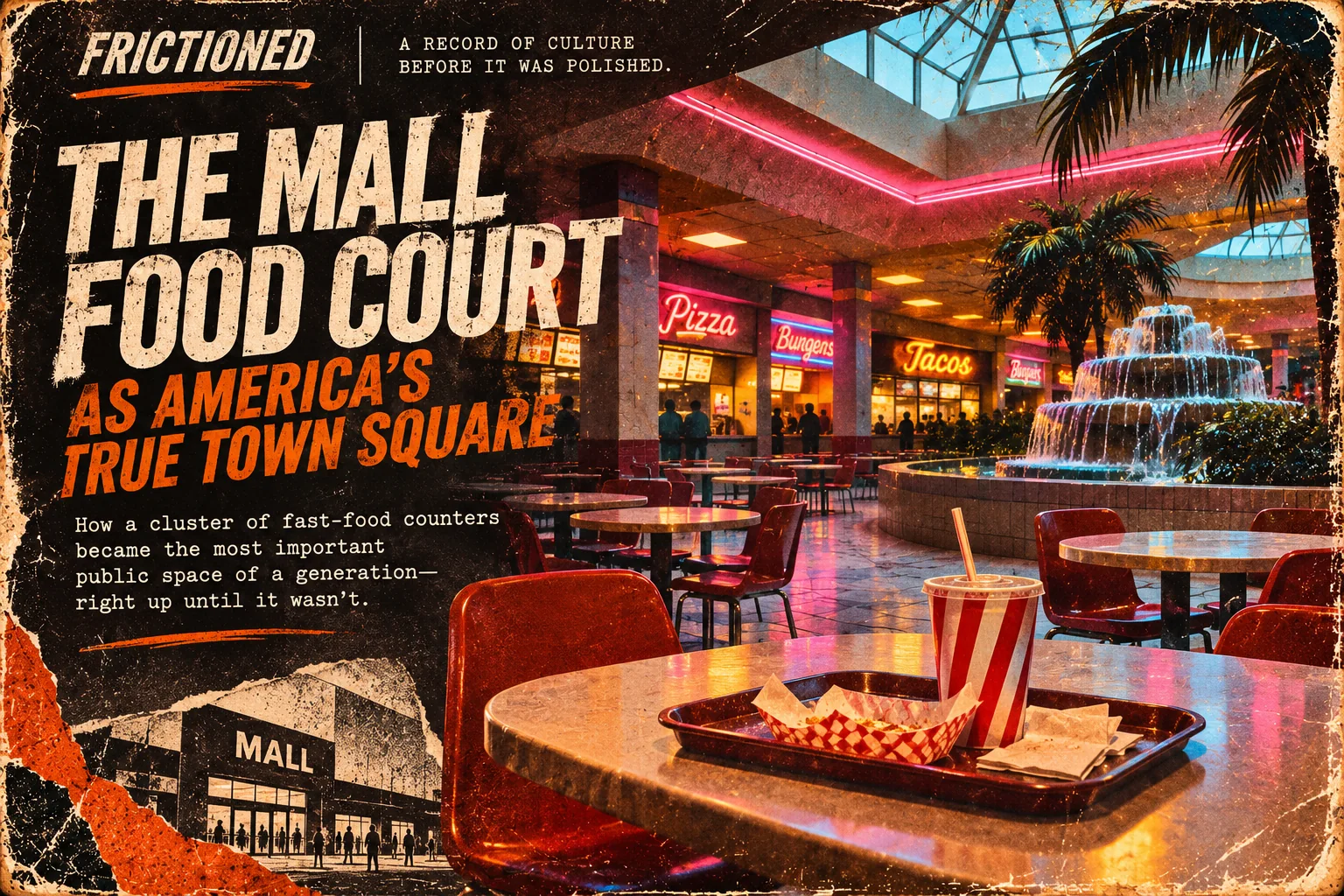
A few malls remain busy. Others have been renovated, repurposed, or abandoned. Some food courts are now sleek dining halls; others still wear the same tile and plastic chairs. There is no single ending to the American mall.
What has changed is how easy it is to assume that the people you want to see will be in one physical place. Messaging apps can assemble a group in seconds, but they cannot entirely reproduce the strange education of sitting in a room full of people you did not choose.
Picture a food-court table after the lunch rush. A damp ring left by a cup. A salt packet on the floor. The light still on, the chairs still waiting. Without the crowd, the setting looks absurdly ordinary.
That was always the secret. The town square was never the tile, the counters, or the fries. It was the permission—however conditional—to gather without much of a plan.
The food court wasn't really ours.
For a little while, we used it as though it were.