
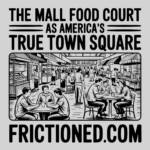

The Glow You Didn’t Question
You didn’t notice the light at first.
It was just there—flat, even, eternal. A daylight that never moved.
The food court smelled like everything at once. Fry oil. Sugar. Hot plastic. Cleaner strong enough to erase fingerprints and memory. Trays slid across laminate tables. Pagers buzzed. Shoes squeaked. Somewhere a soda machine hissed like it was alive.
No windows. No clocks. No sense of outside.
You could sit there for hours and never feel time pass. Afternoon stayed afternoon. Hunger became optional. You weren’t early or late—you were simply there. That was the trick. The glow didn’t ask questions. It didn’t care who you were with or what you were doing, as long as you stayed inside the lines.
This place felt public.
But it wasn’t.
It felt like freedom.
But it was supervised.
The mall food court didn’t replace the town square loudly or intentionally. It just slid into the role while no one was paying attention. A space where you could gather without a reason. Where teenagers practiced independence using pocket money and plastic trays. Where choice existed, but only inside a carefully drawn box.
The glow made it feel normal.
And because it felt normal, no one questioned it.
The Disappearance of the Real Town Square
The old town square didn’t disappear in a single moment.
It thinned out. It got quieter. Then it stopped being necessary.
Once, public space existed without a receipt. A square, a main street, a park bench. Places where people crossed paths without planning to. Teenagers hovered. Old men watched. Kids ran in circles. You didn’t have to do anything to be there. You just showed up.
Suburbia broke that rhythm.
Houses spread outward. Streets stopped connecting. Sidewalks vanished or led nowhere useful. Everything meaningful moved behind windshields and parking lots. If you weren’t driving somewhere, you weren’t going anywhere at all.
The mall arrived as a solution that didn’t admit what it was solving.
It was walkable, but only inside. Social, but regulated. Public, but privately owned. You could wander, linger, meet friends, people-watch—activities once reserved for streets and plazas—without the inconvenience of weather, unpredictability, or genuine public ownership.
And within the mall, the food court became the closest thing to a square.
It was the only place you didn’t need a mission. You didn’t have to browse. You didn’t have to buy much. You could sit, wait, talk, laugh too loud, exist in a group. For a few dollars, you bought permission to occupy space.
That was the trade.
The town square died not because people stopped needing it—but because it was replaced with something easier to manage.
Why Teenagers Took Over
Teenagers didn’t choose the food court by accident.
It was one of the few places that tolerated them.
They had time. Long stretches of it. Afternoons that stretched into nothing. Evenings too early to go home, too late to be supervised closely. They had social energy and nowhere to put it. Bedrooms were private but isolating. Streets were suspicious. Parks were watched. Convenience stores wanted you in and out.
The mall food court asked for very little.
Parents could drop you off and feel responsible without being present. Security guards existed, but they stayed at the edges—visible enough to keep things from getting wild, distant enough to ignore most of what mattered. Noise blended into noise. Laughter disappeared into the echo.
Money helped, but not much was required. One drink. One basket of fries. Enough to justify sitting there for hours. The transaction wasn’t food—it was access.
For teenagers, the food court became a testing ground.
It was where you learned how to be seen without being a child. How to sit in public without supervision. How to negotiate group dynamics, flirtation, rejection, boredom. Where status was displayed through shoes, haircuts, who you sat with, and who worked behind the counter.
Some kids served the food. Others pretended not to see them.
It was a rehearsal for adult life, staged in plastic chairs under artificial sun, where freedom felt real enough to practice—without ever being real at all.
The Illusion of Choice
From a distance, the food court looked like abundance.
Bright signs. Competing logos. Menus shouting at you in different fonts. Pizza, tacos, chicken, noodles. A dozen options arranged in a loose circle, all promising something different. The question “What are you getting?” felt like a meaningful decision.
It wasn’t.
No matter where you ordered, the outcome was the same. Salt. Sugar. Grease. Meat reshaped into familiarity. Comfort disguised as variety. The differences were cosmetic—sauces, wrappers, cultural costumes draped over the same base ingredients.
But the choice mattered socially.
Standing in line was a performance. You scanned menus you already knew. You hesitated just long enough to signal taste. You aligned yourself with a brand, a vibe, a tribe. Your tray became a small declaration of who you were—or who you wanted to be seen as.
Spending four or five dollars wasn’t about eating. It was the toll you paid to remain present. To sit without being asked to leave. To participate in the illusion that you had chosen something freely.
This was early training.
You learned how to navigate approved options. How to confuse selection with agency. How to feel independent while moving inside a carefully fenced range of possibilities.
The food court didn’t sell meals.
It sold the feeling of choice—cheap, repeatable, and easy to swallow.
Artificial Sunlight and Timelessness
The light never changed.
That was the first thing you stopped noticing. No shadows sliding across the floor. No dimming toward evening. No sudden brightness when clouds broke. Just the same steady glow, locked in place like a paused afternoon.
There were no windows to contradict it. No clocks to challenge it.
Inside the food court, time became abstract. You didn’t arrive at a moment—you entered a condition. Hunger wasn’t tied to hours. You ate because you were there, not because it was noon or six. You left when something else finally pulled you away.
This wasn’t accidental design. It was intentional comfort.
Artificial sunlight removed friction. It erased the outside world—the weather, the seasons, the passing of the day. Rain didn’t matter. Heat didn’t matter. Darkness didn’t arrive. You could linger without consequence, suspended in a permanent in-between.
For teenagers especially, this mattered. Time usually belonged to someone else—school bells, curfews, rides home. The food court loosened that grip. It felt endless, even if it wasn’t. A place where nothing pushed you forward and nothing demanded you leave.
It trained people to live indoors. To accept simulation over sensation. To mistake stability for safety.
The glow didn’t feel fake.
That’s why it worked.
Controlled Chaos: Security, Rules, and Soft Policing
The food court felt loose, but it was never lawless.
There were rules everywhere, even if no one recited them out loud. You learned them by watching. By noticing who got corrected and who didn’t. By sensing where the line was without ever seeing it drawn.
Security guards were part of the scenery. Not cops. Not friends. Just present enough to remind you that this freedom had conditions. They leaned on railings. Walked slow loops. Made eye contact without confrontation. Authority, softened for retail.
You could be loud, but not too loud.
You could stay, but not forever.
You could gather, but not spill over.
Fights ended quickly. Running drew attention. Too much chaos triggered a response. The goal wasn’t punishment—it was smoothing things back into place. Keeping the illusion intact.
For teenagers, this was an education in power. Not the hard kind that slams doors and writes tickets, but the quiet kind that watches and waits. You learned how to test boundaries without crossing them. How to look harmless. How to exist just below the threshold of trouble.
The food court wasn’t about control through force.
It was control through presence.
You were free to move, talk, sit, and linger—as long as you remembered whose space it really was.
The Food Court as a Social Equalizer
On the surface, the food court flattened everything.
Rich kids and poor kids ate the same fries. Everyone carried the same flimsy trays. Plastic cups sweated onto the same tables. For a moment, it looked like class didn’t matter. Like money stopped at the entrance and everyone played by the same rules.
That was the illusion.
The differences were quieter, harder to name. Who paid without checking their wallet. Who split a meal. Who worked behind the counter instead of sitting in front of it. Who could leave whenever they wanted, and who needed a ride that hadn’t arrived yet.
Still, something real happened there.
The food court forced proximity. You couldn’t fully segregate. You shared space with people you wouldn’t normally choose. You watched other lives unfold at arm’s length. You learned how to read people quickly—who had status, who didn’t, who was pretending, who was exhausted.
It was a rehearsal for adulthood’s contradictions.
Everyone was technically equal, but everyone knew they weren’t. The lesson wasn’t fairness—it was awareness. How hierarchy survives even when the setting pretends it doesn’t.
The food court didn’t erase class.
It just taught you how to recognize it without anyone saying the word.
The Crackdown and the End of the Era
The shift didn’t come with an announcement.
It came with signs.
“No loitering.”
“Unaccompanied minors prohibited.”
Curfews printed in neutral fonts, posted at entrances no one read until it was too late.
The mall stopped pretending.
Teenagers, once tolerated as atmosphere, became a liability. Groups lingered too long. Bought too little. Took up space without converting it into enough revenue. What had once been framed as community was reclassified as a problem.
Security changed tone.
More walking. Less leaning.
Rules hardened.
The food court’s role narrowed. Sitting became conditional. Hanging out required justification. Freedom now had an expiration time and a chaperone requirement.
This wasn’t about safety.
It was about efficiency.
The mall no longer needed a town square. It needed turnover. The illusion of public space collapsed the moment it stopped being profitable. What remained was a transaction zone—eat, buy, leave.
And just like that, an entire era of accidental freedom ended.
What Replaced It (or Didn’t)
When the food court faded, nothing physical stepped in to replace it.
There was no new place to sit for hours without a purpose. No neutral ground where boredom, conversation, and proximity could coexist. The need didn’t disappear—it went looking for a new container.
It found one in screens.
Social media became the new food court. Always open. Always lit. Endless seating. You could show up, see who was there, drift between groups, perform identity, and leave without explanation. Presence without commitment. Visibility without risk.
But something was missing.
There’s no shared air online. No overheard laughter. No accidental eye contact. No learning how to exist next to people you don’t fully choose. The chaos is curated. The surveillance is total. Every movement logged, ranked, optimized.
The mall food court was supervised, but it wasn’t intimate. You could disappear into it. Online, you’re never really gone.
What replaced the food court didn’t offer freedom—it offered simulation. A version of togetherness without friction, without bodies, without the low-stakes awkwardness that once taught people how to be social in real space.
Nothing truly replaced it.
Something more efficient took its place.
The Saddest Tray in America
Walk through a dead mall today and you’ll find it.
The food court, still arranged like it’s waiting for a crowd that never shows. Metal gates half-down. Menu boards frozen on outdated prices. A few tables pushed together as if someone meant to come back.
The trays are gone now. Or stacked behind counters that haven’t opened in years. But you can still see where they used to land. You can hear the echo if you stand still long enough.
The mall food court was never good.
The food was mediocre. The light was fake. The freedom was conditional.
But it was there.
It gave people—especially teenagers—a place to practice being human in public. To sit without a script. To be bored together. To learn how power worked, how money mattered, how choice could feel real even when it wasn’t.
It wasn’t a town square.
It was training for life without one.
And when it disappeared, it didn’t take comfort with it.
It took the last place you could sit for hours, spend five dollars, and feel like the world hadn’t decided what you were for yet.