
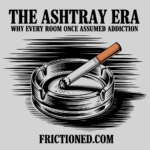

The Object Nobody Questions
The ashtray didn’t announce itself.
It didn’t demand attention.
It simply existed — already waiting.
On coffee tables.
On nightstands.
Bolted into airplane armrests.
Built into hospital waiting rooms.
Sitting between salt and pepper at diners like it belonged there as much as taste itself.
No one asked why it was there.
That was the point.
The ashtray wasn’t a personal item. It wasn’t something you brought with you, like a lighter or a pack of cigarettes. It was part of the room. Part of the assumption. The space expected something of you before you even sat down.
That expectation wasn’t leisure.
It wasn’t choice.
It was dependency.
Every room quietly assumed that someone, sooner or later, would need to burn something to get through the moment.
Waiting?
Smoke.
Thinking?
Smoke.
Talking too long?
Smoke.
Sitting with discomfort?
Definitely smoke.
The ashtray existed to absorb anxiety. To catch nerves. To hold the physical residue of stress. It was a designated place for the evidence of coping.
And because it was everywhere, it stopped looking strange.
A society doesn’t need to tell people what to do when the furniture already knows.
The presence of the ashtray wasn’t about encouraging smoking. That’s how it’s often framed now — as a cultural mistake, a lapse in medical understanding, a different time. But that explanation dodges the deeper truth.
The ashtray wasn’t ignorance.
It was permission.
Not spoken.
Not written.
Just implied through repetition.
It told you that whatever you were feeling — boredom, dread, tension, loneliness — was normal enough to plan around. That needing chemical relief wasn’t a flaw. It was expected. So expected, in fact, that buildings were designed to accommodate it.
Addiction didn’t interrupt life.
Life was arranged around it.
And when something is this ordinary, this integrated, this unquestioned, it becomes invisible. Like wallpaper. Like hum. Like background smoke drifting through decades.
The ashtray was never just a container for ash.
It was a cultural admission — quietly placed on the table — that being human required a little damage.
And everyone agreed not to talk about it.
When Addiction Was Built Into Architecture
The ashtray didn’t sit on rooms.
It was part of them.
Molded into armrests.
Recessed into desks.
Bolted to walls.
Cast into ceramic counters like plumbing fixtures.
You couldn’t move it without tools.
That’s the detail that matters.
When something is built in, it stops being a habit and starts being infrastructure. Architecture is belief made solid. It reveals what designers think people will do — not occasionally, but routinely.
Homes once came with ashtrays as standard decor. Office desks were designed with circular depressions sized perfectly for cigarettes. Cars didn’t just allow smoking — they powered it. The lighter wasn’t an accessory. It was factory-installed.
You could remove the radio.
You could upgrade the seats.
But the cigarette lighter was non-negotiable.
Because the assumption wasn’t if you’d smoke.
It was when.
Airplanes sealed hundreds of people into metal tubes and then provided ashtrays in every armrest, as if the danger wasn’t the fire — it was the inconvenience of nowhere to put the remains. Hospitals treated lung disease while offering places to stub out the cause. Schools punished students for smoking while staff lounges filled with smoke thick enough to taste.
Contradiction didn’t bother anyone.
The system wasn’t confused.
It was compartmentalized.
Addiction could be acknowledged as harmful and still treated as inevitable. Architecture solved the discomfort of that contradiction by managing the mess instead of questioning the behavior.
Contain it.
Organize it.
Make it look civilized.
The ashtray was a design solution to human weakness.
Not prevention.
Not confrontation.
Just accommodation.
This is how environments quietly shape behavior. Not by commanding it, but by preparing for it. When a space is ready for something, it subtly invites it. The room whispers, this happens here.
And people listen.
No one walked into a hotel room and thought, I should start smoking. But the presence of the ashtray made the act feel compatible with rest, with privacy, with adulthood. It suggested that stress belonged indoors. That relief was part of the furnishings.
Architecture doesn’t moralize.
It normalizes.
A chair tells you to sit.
A bed tells you to sleep.
An ashtray tells you that burning yourself slowly fits comfortably into the day.
Over time, the expectation becomes so deep it disappears. You stop seeing the object as strange and start seeing the absence as strange instead. When ashtrays were removed, rooms felt incomplete. Empty. Wrong.
Something was missing — not because people missed smoking, but because the environment had trained them to expect permission.
This is the power of built-in behavior.
When addiction is portable, it feels like a personal flaw.
When addiction is structural, it feels like culture.
And culture is harder to argue with — because it doesn’t speak.
It just sits there.
Waiting.
Smoking Wasn’t a Vice — It Was a Social Rhythm
Smoking didn’t interrupt life.
It paced it.
A cigarette wasn’t treated like indulgence or escape. It was treated like punctuation. A pause between sentences. A way to mark transitions the body didn’t know how to name.
Start the day.
Light up.
Finish a task.
Light up.
Waiting for someone who’s late.
Light up.
Nothing to say.
Light up anyway.
The cigarette wasn’t about craving as much as timing. It gave structure to moments that otherwise felt formless. In a world with fewer notifications and no glowing rectangles demanding attention, people used smoke to measure time.
Five minutes.
Ten minutes.
One cigarette’s worth.
That was the unit.
Workplaces ran on it. “Smoke breaks” weren’t rebellion — they were policy. The act of stepping outside together created unofficial meetings, brief confessions, alliances formed in cold air. Important conversations happened leaning against brick walls, sharing lighters, exhaling in sync.
You didn’t smoke alone.
You smoked with.
And that togetherness mattered.
The cigarette created instant intimacy. Strangers bonded over borrowed fire. Silence became comfortable when both mouths were busy. Eye contact wasn’t required. The smoke did the talking.
In this way, addiction disguised itself as ritual.
Lighting up wasn’t framed as needing something — it was framed as doing something. A gesture. A rhythm. A habit so woven into social movement that refusing it could feel antisocial.
To not smoke wasn’t immoral.
It was inconvenient.
Smokers stepped outside together. Non-smokers stayed behind. Information traveled with the smoke. Promotions were discussed in doorways. Gossip followed the ember trail. You didn’t need to participate — but you’d miss things if you didn’t.
This is how behaviors become powerful.
Not because they feel good.
But because they synchronize people.
Smoking aligned breathing. Paused conversation at the same intervals. Created shared beginnings and shared endings. It turned internal need into external choreography.
And when addiction becomes choreography, it stops looking like harm.
It looks like culture.
The body learned to associate nicotine not just with relief, but with belonging. With breaks. With laughter. With the end of effort. The chemical effect fused with memory until separating the two felt unnatural.
People didn’t say, I need a cigarette.
They said, Let’s take a break.
Language did the rest.
By renaming the act, the dependency vanished from view. What remained was the rhythm — inhale, exhale, talk, wait, return. The body learned when to crave based not on chemistry alone, but on context.
Time itself became conditioned.
When something organizes your day, your conversations, your pauses, it ceases to feel optional. Removing it doesn’t just remove a substance — it collapses a structure.
This is why quitting felt like losing something larger than nicotine.
People didn’t miss the smoke.
They missed the rhythm.
And when the ashtray disappeared, it wasn’t just a health shift.
It was the end of a shared tempo — one that had quietly governed how people moved through their lives together.
Permission Without Saying the Word
No sign ever said you were allowed to hurt yourself here.
There was no announcement.
No disclaimer.
No moral language at all.
Just the ashtray.
That’s how permission works when it’s done well — it doesn’t speak. It doesn’t argue. It doesn’t persuade. It simply makes space and waits for you to step into it.
The ashtray never told anyone to smoke. It didn’t have to. Its presence answered the question before it was asked. Yes, this is acceptable. Yes, this belongs here. Yes, this is normal.
Permission is most powerful when it’s invisible.
Rules draw resistance.
Warnings provoke debate.
But silent approval slides straight past the mind.
When an object exists everywhere, it communicates inevitability. It suggests that whatever it supports must be part of human nature — something too common to fight, too widespread to question.
You don’t argue with gravity.
You arrange furniture around it.
That’s what society did with smoking.
The ashtray said: people will need this. Not some people. Not troubled people. People.
By preparing for harm instead of discouraging it, culture transformed damage into expectation. The act stopped feeling transgressive and started feeling aligned. You weren’t breaking rules. You were using the room correctly.
This is the difference between tolerance and endorsement.
Tolerance says, we’ll allow it.
Endorsement says nothing — and lets the environment do the talking.
There was no moment where society openly decided that addiction was acceptable. No vote. No announcement. Just decades of quiet accommodation until the line blurred and then vanished entirely.
Once something is expected, refusal begins to feel strange.
Not smoking wasn’t rebellious.
But it was noticeable.
The smoker blended into the landscape. The non-smoker became the variable. The one who had to adjust. Step aside. Move away. Decline politely.
Permission doesn’t always push people toward behavior.
Sometimes it pulls everyone else around it.
This is how harm becomes social glue.
Not because people love it — but because it’s easier to participate than to stand out. Easier to accept the offered rhythm than to challenge the architecture of the moment.
The ashtray didn’t moralize addiction.
It normalized it.
And normalization is far more dangerous than encouragement. Encouragement can be resisted. Normalization becomes background radiation — constant, invisible, unquestioned.
When something doesn’t require justification, it doesn’t invite reflection.
It simply exists.
And the most powerful message it delivered wasn’t about smoking at all.
It was about how much damage a society is willing to quietly permit — as long as it’s shared, familiar, and neatly contained.
No words required.
The table already said yes.
Children Grew Up Inside the Fog
For children, the smoke was never a choice.
It was atmosphere.
Cars filled slowly with it, windows cracked an inch as compromise. Living rooms carried a permanent haze, visible only when sunlight cut across the room at the right angle. The smell lived in curtains, in couch fabric, in winter coats hanging by the door.
It wasn’t dramatic.
That’s what made it powerful.
No one said this was dangerous in a way a child could understand. No alarms went off. No one panicked. The smoke didn’t feel like an event — it felt like weather.
You grew up inside it.
Children learned early how to read adults by the length of a cigarette. Short ones meant tension. Long ones meant stories. Ash growing too far meant someone was distracted. The ember became a mood indicator.
This was education without instruction.
Kids adapted their breathing without knowing they were adapting. They learned where to sit to avoid the worst of it. Which rooms smelled heavier. How to angle their heads away during hugs.
They didn’t complain.
Because nothing looked wrong.
Adults laughed. The TV played. Dinner was served. The room functioned. When harm exists inside normalcy, it doesn’t register as harm — it registers as life.
The ashtray beside the bed said something no one articulated: this follows us everywhere. Even into sleep. Even into rest. Even into places meant to be safe.
And safety learned under these conditions becomes elastic.
When children grow up surrounded by normalized damage, they internalize a quiet lesson: discomfort is something you endure, not something you name. If everyone else seems fine, then whatever you feel must not matter much.
So they adjusted.
They learned that love could smell like smoke. That care could come with coughing. That warmth and harm could occupy the same space without contradiction.
This is how confusion is passed down gently.
No one intended to teach it.
That’s the tragedy.
Children didn’t see addiction as a problem. They saw it as furniture. As something adults had — like keys, wallets, and worries. A grown-up object. A grown-up need.
And because it was everywhere, it became invisible again.
Only later — decades later — would many realize how strange it was. How much effort went into pretending nothing was happening. How the body remembered long before the mind had words for it.
Memory doesn’t archive facts.
It archives atmosphere.
For a generation, that atmosphere was blue and drifting and constant.
The fog wasn’t just smoke.
It was the feeling that certain harms were too ordinary to interrupt life for.
And once a child learns that lesson, it doesn’t stay in the lungs.
It settles deeper.
Cleanliness Was Redefined to Include Filth
The ashtray wasn’t there to stop the mess.
It was there to make the mess acceptable.
Cleanliness, during the Ashtray Era, didn’t mean absence. It meant containment. Smoke could fill a room as long as the ashes stayed put. Burn marks were failure — ash inside the dish was order.
This distinction mattered.
A table covered in ash was dirty.
A table with an ashtray full of ash was tidy.
The harm remained the same. Only the presentation changed.
Society didn’t remove the behavior — it reorganized the evidence. Filth was permitted as long as it stayed inside its designated boundaries. The mess became respectable once it had a vessel.
This logic spread quietly.
Hotels didn’t smell clean — they smelled managed. Offices weren’t free of smoke — they were structured around it. The presence of ashtrays signaled responsibility, not indulgence. You weren’t careless if you smoked. You were careless if you flicked ash where it didn’t belong.
Discipline replaced restraint.
It was no longer about stopping harm.
It was about keeping it neat.
This is how cultures learn to live with damage indefinitely.
By focusing on surfaces instead of causes, society trained itself to feel virtuous without changing anything. The ashtray offered moral relief. At least we’re being clean about it.
But cleanliness became performance.
The air could be toxic.
The lungs could suffer.
The walls could yellow.
As long as the carpet wasn’t burned, everything was considered under control.
This reframing allowed people to feel responsible while continuing exactly as before. The ashtray absorbed guilt along with ash. It gave the illusion of order in a system slowly coating itself in residue.
And illusions matter.
Once damage looks organized, it stops triggering alarm. The brain relaxes. The danger feels handled — even when it isn’t. Especially when it isn’t.
Cleanliness became cosmetic.
A wipe-down culture emerged: wipe the table, empty the tray, reset the scene. Tomorrow, repeat. No confrontation required. No reckoning necessary.
The room could be refreshed without ever being healed.
This logic didn’t stay with smoking.
It bled outward into everything else.
Pollution managed, not reduced.
Stress medicated, not examined.
Burnout accommodated, not questioned.
If there’s a container for it, it must be okay.
The ashtray taught an entire generation that filth could coexist with respectability — that decay, when properly organized, could pass as normal life.
Not clean.
Just clean-looking.
And once a culture accepts that distinction, it becomes very good at living inside slow damage without ever calling it what it is.
The Psychology of Shared Addiction
When everyone is doing it, no one feels addicted.
That’s the quiet relief of collective behavior. The burden of self-examination evaporates when your reflection looks like everyone else’s. The question Is this a problem? never forms, because nothing stands out enough to provoke it.
Addiction thrives in crowds.
Not because the substance changes — but because perception does.
When harm is shared, it stops feeling personal. The individual no longer carries the weight of choice. The environment absorbs it. The group dilutes it. Responsibility becomes abstract, dispersed across rooms full of people doing the same thing at the same time.
If everyone needs it, then no one needs it too much.
This is the psychology that kept the ashtray innocent.
Smoking didn’t feel like dependency because dependency implies isolation. It implies secrecy. It implies something happening behind closed doors. But smoking happened in the open. Publicly. Casually. With witnesses.
Addiction was visible — which paradoxically made it invisible.
Shame requires contrast.
Without contrast, it starves.
When a behavior is mirrored everywhere, the mind stops tagging it as risk. The internal alarm system quiets. The act blends into routine until it feels no more meaningful than sitting or standing.
This is why people often defended smoking most aggressively when it was challenged.
Not because they didn’t understand the health risks — many did. But because the challenge threatened something deeper than habit. It threatened the shared agreement that made the habit emotionally tolerable.
If this is wrong, then what have we all been doing together for decades?
That question is unbearable.
So the mind rejects it.
Collective addiction protects itself not through denial of facts, but through preservation of belonging. To question the behavior is to question the group. And humans will sacrifice logic long before they sacrifice connection.
The ashtray symbolized safety in numbers.
It said: you are not alone in this. Look around. Everyone else is doing the same thing. Sit down. Relax. You’re normal here.
And normality is the strongest drug of all.
When addiction becomes identity-neutral, it loses its warning signs. There is no “type” to point to. No outlier to caution against. The behavior floats free of stigma and settles into the middle of society.
You can’t spot a problem when it has no edge.
In this way, shared addiction becomes self-sustaining. It doesn’t need propaganda. It doesn’t need pressure. It simply needs continuity — one generation watching the last do the same thing without catastrophe erupting fast enough to interrupt belief.
Slow harm is easy to dismiss.
Especially when everyone is aging together.
The ashtray allowed people to think, If this were truly dangerous, someone would have stopped us by now.
And in that assumption, the final defense locks into place.
Not ignorance.
Trust.
Trust in the collective.
Trust in the room.
Trust in the fact that nothing feels urgent — yet.
This is the deepest psychology of the Ashtray Era.
Not that people didn’t know.
But that knowing alone isn’t enough to override the comfort of doing harm together.
The Moment the Ashtray Disappeared
It didn’t happen gradually.
That’s what people remember wrong.
The Ashtray Era didn’t fade — it collapsed.
One year the ashtray was everywhere.
The next, it was gone.
Not hidden. Not redesigned. Removed.
Airplanes stripped them from armrests. Restaurants cleared tables between shifts and never put them back. Office buildings posted signs where objects used to sit. Hotels swapped ceramic dishes for laminated warnings.
No debate.
No mourning.
No explanation.
Just absence.
And absence is loud.
People noticed immediately — not because they missed smoking, but because something foundational had been altered. The room no longer agreed with them. The environment stopped cooperating.
What had once felt neutral now felt transgressive.
Same act.
Same person.
Different permission.
The speed of the shift revealed something uncomfortable: culture had never been undecided. It had simply changed its mind. And when it did, it did so without ceremony.
There was no apology for the decades of normalization. No acknowledgment of contradiction. No reckoning with the fact that institutions once built spaces around a behavior they now condemned.
The ashtray vanished as if it had never existed.
That disappearance created whiplash.
People who had spent their entire adult lives operating within an accepted rhythm suddenly found themselves framed as problems. What had once been background noise became disruption. What had once been social became isolating.
Smokers were pushed outside — literally.
The behavior didn’t stop overnight, but its meaning inverted. The same cigarette that once signaled pause and connection now signaled inconvenience. The same smoke that once gathered people now separated them.
Culture flipped the polarity.
This is how moral change often works — not through persuasion, but through environmental betrayal. The room withdraws support, and the body follows slowly after.
The ashtray’s disappearance taught a quiet lesson: behavior is far more dependent on surroundings than belief. People didn’t suddenly become healthier. They became unsupported.
And unsupported behaviors feel heavier.
Once the object was gone, smoking had to be intentional again. It required planning. Leaving the room. Standing alone. A break became a departure.
That friction mattered.
It exposed how much the habit had relied on silent cooperation.
More unsettling was how easily everyone adapted.
The same society that once assumed addiction now assumed restraint — without ever addressing the gap between the two. No one asked what else might be just as normalized now, waiting its own sudden erasure.
The ashtray didn’t disappear because people changed.
People changed because the ashtray did.
That’s the part we rarely acknowledge.
We like to tell stories about awareness, education, progress. But the real transformation came when the furniture stopped agreeing with us.
When permission was withdrawn, behavior followed — reluctantly, unevenly, but inevitably.
And once again, culture didn’t argue.
It rearranged the room.
What Replaced the Ashtray
The ashtray didn’t leave a vacuum.
Something always fills the space.
Addiction doesn’t disappear when one object is removed — it relocates. It changes shape. It becomes quieter. More efficient. Less visible to others and more intimate with the body.
When smoking was pushed out of rooms, coping didn’t vanish.
It went inward.
Nicotine became portable. Digital. Odorless. Phones replaced lighters. Screens replaced smoke. Caffeine replaced pauses. Pills replaced permission. Scrolling replaced exhaling.
The function stayed.
Only the ritual changed.
Where smoke once marked a break, now a glance at a screen does the same work. Where stepping outside once gave relief, now a notification interrupts discomfort just long enough to continue.
The ashtray had been communal.
Its replacements are solitary.
No shared exhale.
No synchronized pause.
No small talk while burning time.
Modern coping happens silently, individually, with eyes down and bodies still.
We didn’t remove addiction from the room.
We privatized it.
This is the crucial shift.
The Ashtray Era allowed harm to be social — messy, visible, undeniable. Today’s versions are clean. Efficient. Frictionless. They don’t leave residue on furniture. They don’t stain walls. They don’t announce themselves.
They live in pockets.
Rooms are now designed not to accommodate smoke, but to accommodate distraction. Tables include charging ports. Airports glow with outlets. Waiting areas assume stimulation, not patience.
We no longer ask people to sit with discomfort.
We design environments that erase it instantly.
The modern ashtray doesn’t collect ash.
It absorbs attention.
And attention is easier to monetize, easier to manage, easier to keep invisible.
What once drifted through the air now flows through algorithms. What once smelled like tobacco now smells like nothing at all — which makes it harder to detect, harder to resist, harder to explain.
Nobody coughs from scrolling.
No ceiling turns yellow from stress.
The damage doesn’t announce itself in rooms anymore.
It accumulates behind the eyes.
This shift allows society to feel cleaner than it actually is. No smoke, no mess, no evidence. Just fatigue, anxiety, and a constant low hum of unease that never quite clears.
We congratulate ourselves for removing the ashtray — while ignoring the fact that the room still expects people to cope chemically or digitally to remain functional.
We just changed the container.
Where addiction was once acknowledged openly, it is now denied privately. Where harm once required shared tolerance, it now hides behind productivity and convenience.
The ashtray told you that struggle was expected.
Its replacements tell you that struggle should be silent.
And that may be the most significant change of all.
The New Ashtrays We Don’t Notice Yet
Every era believes it has outgrown its blind spots.
That’s how blind spots work.
The ashtray once felt neutral. Sensible. Practical. No one saw it as symbolic until it vanished. Only in absence did its meaning become visible.
The same thing is happening now.
Our rooms are still filled with objects that quietly anticipate our weaknesses — we just don’t call them that. We call them features. Amenities. Thoughtful design.
Phone trays at restaurant tables.
Charging ports built into couches.
Power outlets placed beside beds.
Screens mounted everywhere people might otherwise wait.
These aren’t conveniences by accident.
They assume something.
They assume restlessness.
They assume anxiety.
They assume the inability to be alone with silence for more than a few minutes.
And they prepare for it.
Break rooms are stocked not for nourishment, but for stimulation. Energy drinks where water used to be. “Focus” supplements next to coffee. Quiet rooms not for reflection, but for recovery — spaces designed to help people survive systems they’re never meant to question.
Burnout has its own furniture now.
We don’t call these things permission. We call them support. But support, when it becomes permanent, reveals expectation. The environment doesn’t ask if you’ll be depleted.
It plans for it.
Just as ashtrays once planned for addiction, modern spaces plan for overload. For exhaustion. For fragmentation. For the constant need to self-regulate chemically, digitally, or psychologically just to remain functional.
The new ashtrays don’t collect residue.
They absorb collapse in small, manageable doses.
Ten minutes on a phone.
Another coffee.
A breathing app.
A scroll before sleep.
A scroll upon waking.
Tiny rituals that smooth the edges just enough to keep the machine running.
Nothing looks wrong.
That’s the danger.
When accommodation becomes universal, it stops looking like a warning and starts looking like design philosophy. The room no longer asks people to adapt to life — it adapts life around their inability to cope with how it’s structured.
And that should feel familiar.
The ashtray once made addiction blend seamlessly into daily existence. Today’s equivalents do the same — except now the harm leaves no smell, no stain, no visible aftermath.
Only fatigue.
Only numbness.
Only the sense that time keeps slipping without being felt.
Future generations will look back at our spaces the same way we now look at smoke-filled airplanes and hospital waiting rooms.
They’ll notice the outlets.
The screens.
The constant buffering of experience.
And they’ll ask the same question we ask now:
Why did every room assume people couldn’t sit still?
We won’t have a better answer than the ones given before.
Because when you live inside permission, it never announces itself.
It just sits quietly on the table.
Waiting to be recognized later.
Social Permission as a Control Mechanism
Control doesn’t always arrive with rules.
Sometimes it arrives with comfort.
The most effective systems don’t force behavior — they make alternatives inconvenient. They don’t threaten. They furnish. They arrange life so that certain choices feel natural and others feel disruptive.
This is what social permission actually is.
Not approval.
Not encouragement.
But gravitational pull.
When a behavior is supported by the environment, it becomes the path of least resistance. No mandate is required. People comply simply by moving through the space as designed.
The ashtray was never about smoking.
It was about compliance through accommodation.
By preparing rooms for addiction, society removed friction from harm. And when friction disappears, behavior accelerates quietly. People don’t feel coerced. They feel comfortable.
Comfort is persuasive.
This is why permission functions as a control mechanism. It doesn’t restrict behavior — it narrows imagination. It defines what feels reasonable, what feels expected, what feels like the normal way to exist inside a system.
You can technically refuse.
But refusal requires effort.
Step outside.
Interrupt the rhythm.
Explain yourself.
Become noticeable.
Most people won’t.
Not because they’re weak — but because humans are exquisitely sensitive to social disturbance. We read rooms constantly. We feel when we’re misaligned. Environments teach us how not to stand out.
Permission trains behavior without ever naming itself as authority.
And because it feels optional, it’s rarely questioned.
The ashtray taught people how to cope without complaint. It absorbed stress so the structure didn’t have to change. Instead of asking why life required so much chemical relief, society simply made that relief readily available.
This pattern repeats everywhere power wants stability.
If people are anxious, give them outlets — not answers.
If people are exhausted, give them recovery tools — not relief from cause.
If people are overwhelmed, give them distractions — not space.
Permission keeps systems intact by preventing rupture.
It offers just enough release to stop resistance from forming.
This is the genius — and the danger — of environmental control. Nothing feels imposed. No one feels dominated. Yet behavior stays predictably contained within narrow lanes.
You don’t need to tell people how to live when the room already suggests it.
The ashtray once sat quietly as a mediator between human discomfort and institutional convenience. It allowed life to continue without interruption. Without protest. Without pause long enough to demand change.
That is the real function of socially permitted coping.
Not healing.
Stabilization.
And systems prefer stability above all else.
Even if it slowly harms the people inside them.
Why the Ashtray Still Matters
The ashtray is gone.
But its lesson remains.
It matters not because of what it held, but because of what it revealed — a truth about how societies manage discomfort without ever naming it.
The ashtray proved that culture doesn’t need arguments to shape behavior. It doesn’t need consensus or persuasion. It only needs objects placed in the right locations often enough that they stop being seen.
What we build around people teaches them how to live.
Not explicitly.
Not morally.
But practically.
The Ashtray Era shows how easily harm can become invisible when it’s familiar. How quickly a behavior stops being questioned once it’s assumed. How entire generations can live inside conditions that future ones will find incomprehensible.
And none of it required malice.
That’s what makes it unsettling.
No villain designed the ashtray to control anyone. No conspiracy plotted dependence. The system simply prioritized smooth functioning over reflection — and discovered that accommodating weakness was easier than confronting its causes.
That tradeoff happens everywhere.
It happens when stress is medicated instead of reduced.
When exhaustion is normalized instead of questioned.
When coping tools multiply while root problems remain untouched.
The ashtray matters because it shows how permission works best when it feels humane.
Soft systems endure longer than hard ones.
People resist force.
They adapt to comfort.
The Ashtray Era wasn’t a failure of knowledge. It was a success of normalization. It demonstrates how damage can be collectively accepted not because it’s good — but because it’s manageable.
Contained.
Organized.
Quiet.
Understanding this changes how we look at the present.
It reminds us that what surrounds us is never neutral. That furniture is philosophy. That design carries belief. That the most influential messages in society are often unspoken, resting casually on tables and walls.
The ashtray still matters because it warns us not to confuse absence of outrage with absence of harm.
Just because something is everywhere doesn’t mean it’s harmless.
Just because no one objects doesn’t mean no one is suffering.
Just because a system accommodates pain doesn’t mean it deserves acceptance.
The ashtray is a relic now — but it’s also a mirror.
It asks one enduring question:
What are we living with today simply because it’s been made easy to live with?
What’s Sitting on the Table Today
The ashtray didn’t disappear because people suddenly understood themselves better.
It disappeared because the room changed.
That’s the uncomfortable truth this era leaves behind.
We like to believe progress comes from awareness — from education, from collective moral growth. But the Ashtray Era suggests something more sobering: behavior often follows architecture, not conviction.
We become who the room allows us to be.
That’s why the most important questions aren’t always about what people choose — but about what choices are silently prepared for them. What habits are assumed. What weaknesses are anticipated. What forms of coping are furnished in advance.
Because whatever sits on the table feels permitted.
Today’s tables look cleaner. Sleeker. More intentional. Nothing smolders. Nothing stains the ceiling. The air smells fine.
But the objects are still there.
Glowing screens within arm’s reach.
Endless stimulation disguised as connection.
Tools for calming the nervous system without changing the conditions that keep it activated.
They don’t announce themselves as vices.
Neither did the ashtray.
One day, these objects too will vanish. Quietly. Without apology. Future rooms will feel strange to us. Incomplete. Wrong in ways we can’t articulate.
And someone will write about how we lived — not with disbelief, but with recognition.
They’ll wonder how we sat surrounded by things that assumed exhaustion, distraction, fragmentation — and never thought to question what kind of life required so much management.
They’ll ask why every room expected us to need relief.
And we won’t be here to answer.
Because the most powerful cultural signals don’t come from laws or speeches or headlines.
They come from the objects no one questions.
The ones already waiting when you sit down.
The ones that quietly say:
This is how people live now.
And the moment you stop noticing them is the moment they matter most.