Malcolm McLaren helped turn punk into a public disturbance. The uncomfortable question is whether he was attacking the culture industry—or demonstrating just how easily rebellion could become another product.
The Man Who Sold a Disturbance
Malcolm McLaren had a talent for making a scene. Not necessarily for resolving one, improving one, or leaving its participants particularly happy. He recognized the extraordinary value of a public argument and seemed unusually willing to stand in its path.
He managed the Sex Pistols. He collaborated with Vivienne Westwood on a succession of London boutiques. He turned provocation into imagery, publicity and, eventually, his own legend. The familiar version of the story casts him as punk’s puppet master, tugging the strings while Britain clutched its pearls.
That’s a useful story. It’s also suspiciously neat.
Punk had musicians, designers, fans and arguments of its own. Its roots ran through more than one city. McLaren did not invent its anger. What he did understand was how to put anger on display—and how the resulting outrage could travel.
The mystery isn’t whether he was a genius or a fraud. It’s why, in McLaren’s hands, those descriptions became so difficult to separate.
Art School, With the Safety Catch Removed
Before the tabloids and the Sex Pistols, McLaren moved through British art schools during an era when art itself was being questioned. Situationist ideas, and the related British countercultural milieu, offered a particularly explosive proposition: don’t just make art for people to admire. Interfere with the circumstances in which they live.
The Situationists critiqued a society increasingly experienced through images, performances and commodities. Their ideas weren’t a step-by-step manual for punk, and McLaren was hardly their sole inheritor. But they help explain his attraction to activities that blurred performance, commerce and confrontation.
Instead of making a painting about the absurdity of fashion, why not make fashion behave absurdly? Instead of criticizing the music business from the outside, why not step inside and turn its appetite for spectacle against it?
There was an obvious catch: you could wind up feeding the very machine you wanted to jam.
430 King’s Road: A Shop That Kept Changing the Rules
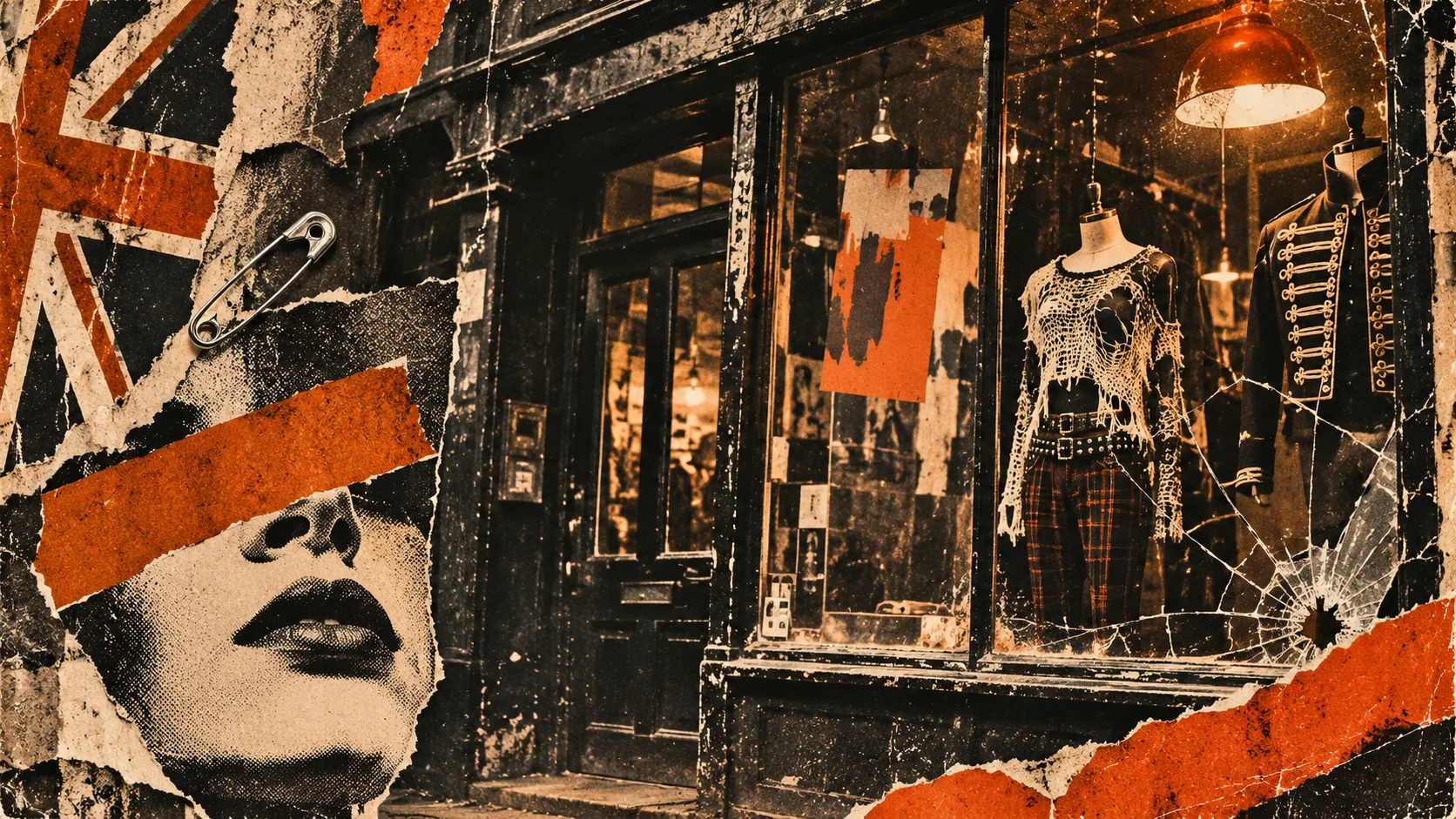
At 430 King’s Road in London, McLaren and Westwood developed a store that repeatedly changed its name, clientele and visual language. Let It Rock embraced Teddy Boy nostalgia in 1971. Too Fast to Live, Too Young to Die turned toward biker style. SEX, launched in 1974, brought fetish-inspired clothing and confrontational graphics to the storefront. Seditionaries followed in 1976; World’s End arrived in 1980.
This wasn’t just a retail makeover every few seasons. Each incarnation tested a different boundary of taste. The clothes could offend, attract, unsettle and confer belonging—sometimes all at once.
But calling the shop McLaren’s invention alone would erase the person doing much of the actual design work. Westwood was central to creating the garments and developing the visual language that became inseparable from British punk. The pair’s partnership mattered precisely because idea, image and manufacture collided in the same small space.
And the shop did sell clothes. That’s the contradiction worth keeping. A customer could buy the uniform of refusal. A piece of anti-establishment style came with a price tag.
1971 — Let It Rock
1972 — Too Fast to Live, Too Young to Die
1974 — SEX
1976 — Seditionaries
1980 — World’s End
Dates and sequence based on the London Museum’s history of the King’s Road boutique.
The Pistols Were Not a Solo Performance
With the Sex Pistols, McLaren found an even louder medium. The band could attract a crowd, an argument, a headline and a ban. To the media, their behavior seemed to confirm everything respectable Britain feared about its young people.
McLaren understood the news value of the clash. But there is a difference between recognizing an opportunity and engineering every outcome. The musicians weren’t props with no agency, and punk’s energy didn’t originate in a manager’s notebook.
This distinction makes the story more interesting, not less. McLaren’s genius—if that’s the word—may have been his willingness to let other people’s combustible creativity collide with institutions that were almost guaranteed to overreact.
He could shape the frame. He couldn’t completely control what happened inside it.
The Swindle That Advertised Itself
After the band’s disintegration, the 1980 film The Great Rock ‘n’ Roll Swindle, directed by Julien Temple, placed McLaren’s manipulative persona near the center of the Pistols’ story. John Lydon did not participate in the production beyond archival appearances.
The film is revealing, but not because it settles what really happened. It’s a performance of control: a manager’s self-mythology dressed as an explanation of a cultural explosion.
Ordinarily, the exposure of a hustle is supposed to spoil it. McLaren found a way to turn the accusation into another attraction. If the audience suspected a scam, the scam itself became part of the entertainment.
That doesn’t absolve manipulation or its costs. It simply explains why the narrative proved so durable: every competing account added another layer to the spectacle.
Rebellion With a Retail Price
What happens when rebellion becomes recognizable? It becomes reproducible. Clothes are copied. Records are repackaged. The threatening visual language of a movement turns into a design vocabulary available to almost anyone.
That transformation isn’t hypothetical. Punk eventually became the subject of major fashion exhibitions, including the Metropolitan Museum of Art’s PUNK: Chaos to Couture in 2013. The museum traced the aesthetic’s journey from do-it-yourself provocation into couture.
This is where McLaren’s story becomes especially uncomfortable. His projects exploited the space between anti-commercial gestures and commercial machinery. But the machinery wasn’t merely a victim. It was also the delivery system. Shops, labels, newspapers and films helped carry the disturbance outward.
Maybe this is what cultural sabotage looks like when nobody can agree which side of the barricade the saboteur occupies.
After Punk, No Fixed Address
McLaren did not stop at the Pistols. He moved through music, film and other projects, drawing on styles and collaborators far removed from punk’s original sound. His album Duck Rock, released in 1983, and later projects such as Fans demonstrated a fascination with sampling, crossover and theatrical collisions.
Those experiments invite admiration and criticism in equal measure. Curiosity about unfamiliar forms can open doors; it can also turn other cultures into raw material for a fashionable concept. A serious account of McLaren has to leave room for both possibilities.
Not every abrupt pivot was necessarily a master plan. Not every commercial failure was a secret victory. Sometimes a project simply failed. Claiming otherwise would turn a complicated artist into the very kind of flawless legend Frictioned ought to distrust.
Culture Before It Was Polished
McLaren is often described as a provocateur, a manipulator, an opportunist, an impresario. Each label captures something, then lets the rest escape.
His most revealing achievement may have been making the separation between rebellion and business impossible to ignore. He could take an unruly cultural impulse, give it a recognizable shape, and put it into circulation. The resulting product might still carry an electric charge. It might also make someone money.
That tension isn’t unique to punk. It is the recurring problem of every underground scene that becomes visible enough to sell: the signal spreads, the symbols harden, and eventually somebody prints the T-shirt.
McLaren didn’t solve that contradiction. He inhabited it, exploited it, and helped make it impossible to miss.
He wasn’t standing outside the machine with a hammer.
He was inside it, selling tickets to the noise.
Further Reading & Sources
- London Museum — Vivienne Westwood & Malcolm McLaren: King’s Road royalty (boutique names, dates, and creative partnership)
- Metropolitan Museum of Art — Vivienne Westwood and the postmodern legacy of punk style (punk’s origins and debates over authorship)
- BFI — The Great Rock ‘n’ Roll Swindle (1980) (film identification)
- BFI — A brief history of punk cinema (film context and Lydon’s nonparticipation)
- Metropolitan Museum of Art — PUNK: Chaos to Couture (the institutional afterlife of punk aesthetics)